

Let's be honest, leg day gets skipped more than any other day of the week. Chest and back get all the glory, biceps get all the mirror time, and legs? Legs get "next time." But here's the thing: you don't need a squat rack the size of a small apartment or a stack of leg machines to build real, functional lower-body strength. A single pulley system, some tension, and the right movements can do more than you'd expect.
If you've been doing your chest flys and lat pulldowns on cables but haven't touched your quads, hamstrings, or glutes yet, this one's for you. Consider this your complete cable leg workout: no bulky machines, no gym membership, no excuses.
Why Cables Are Actually Perfect for Leg Day
Free weights are great, but they have one weakness: gravity only pulls straight down. That means the resistance disappears the moment you're not fighting it vertically. Cables don't have that problem. They keep tension on the muscle through the entire range of motion top, bottom, and everywhere in between.
For legs specifically, that constant tension is gold. Your quads stay loaded through the lockout of an extension. Your hamstrings feel the burn on the way up, not just the way down. And because you can angle a pulley from almost any height or direction, you get movement patterns a barbell or dumbbell simply can't replicate.
This is exactly why leg day without machines doesn't mean leg day without results. A pulley system replicates what a leg extension machine, a leg curl machine, and a cable kickback station would normally do just in a fraction of the space, and without three separate pieces of equipment taking over your garage.
Warming Up Before You Load the Cable
Don't skip this part. Cold hip flexors and stiff ankles are a fast way to turn a good session into a sore one. Spend five minutes on:
-
Bodyweight squats, slow and controlled
-
Walking lunges, 10 steps each leg
-
Leg swings (front-to-back and side-to-side)
-
Ankle circles and a few light glute bridges
Once your joints feel loose and your heart rate is up a notch, you're ready to load the pulley.
Quad-Focused Cable Exercises
Your quads respond really well to constant tension work, which makes them one of the best muscle groups to train with a pulley setup.
1. Cable Leg Extensions Anchor a low pulley, attach an ankle strap, and sit or stand facing away from the tower. Extend your leg forward against the resistance, squeezing at the top before controlling it back down. This mimics the quad extension machine almost exactly, minus the padded seat.
2. Cable Front Squats Set the pulley to chest height, hold the handle at your chest like a goblet squat, and step back to create tension. The cable pulls you slightly forward, which forces your core and quads to work overtime to stay upright. It's a sneaky-effective way to turn a basic squat into something much more demanding.
3. Single-Leg Cable Squats Stand on one leg facing the pulley, holding a handle at chest height for counterbalance, and lower into a single-leg squat. This is one of the best cable exercises for legs if you're chasing balance, stability, and unilateral strength, the kind of thing that actually carries over to running, hiking, and everyday movement.
Hamstring-Focused Cable Exercises
Hamstrings are notoriously undertrained at home because most people only have equipment for leg curls at a commercial gym. A pulley system fixes that gap completely.
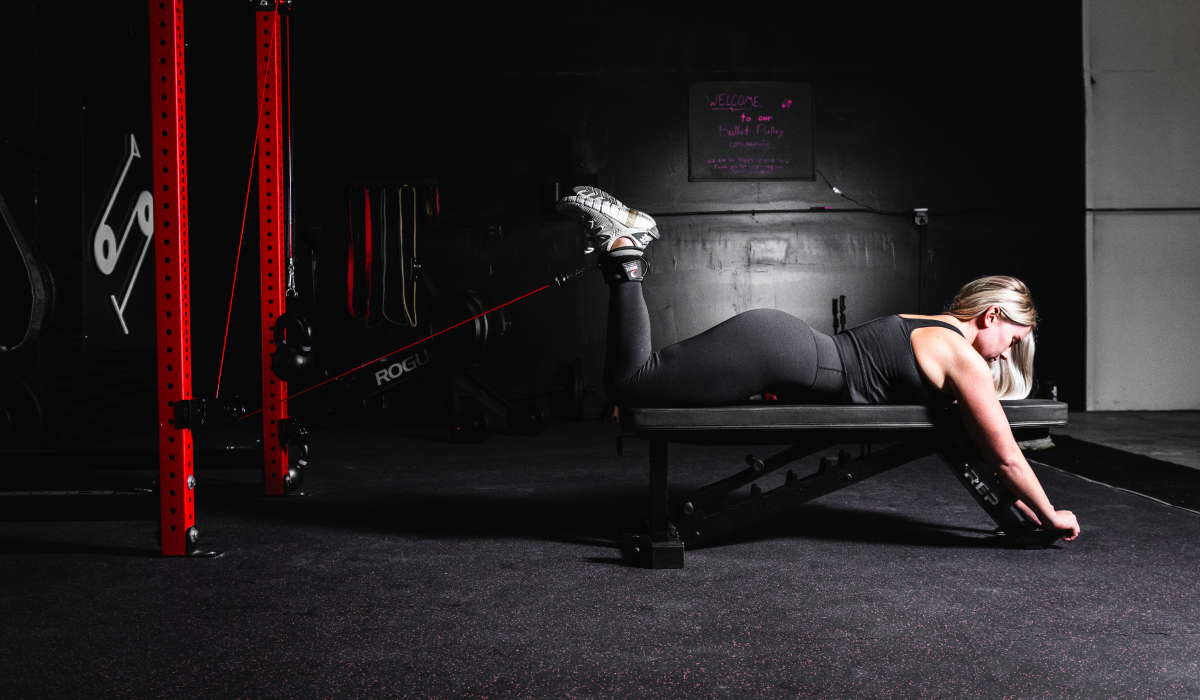
4. Cable Hamstring Curl (Standing) Attach an ankle strap to a low pulley, stand facing the tower, and curl your heel up toward your glute. Keep your hips still and let the hamstring do all the work. This single move is the closest thing to a machine hamstring curl you'll get without owning one, a proper cable hamstring curl that actually isolates the muscle instead of turning into a hip-hinge.
5. Cable Romanian Deadlifts Anchor the pulley low, hold the handle with both hands, and hinge at the hips while keeping a slight knee bend. Push your hips back until you feel a deep stretch in your hamstrings, then drive them forward to stand. The constant cable tension makes this version tougher than a dumbbell RDL in the best way.
6. Cable Good Mornings Set the pulley to shoulder height, loop the handle behind your neck, and hinge forward from the hips with a flat back. This targets the hamstrings and lower back together, which is great for posture if you sit at a desk all day.
Glute-Focused Cable Exercises
If your glutes have been quiet for a while, these will wake them up fast.
7. Cable Kickbacks Attach an ankle strap to a low pulley, face the tower, and kick your leg straight back and up, squeezing hard at the top. Slow and controlled beats fast and sloppy here the squeeze is where the real work happens.
8. Cable Hip Thrusts Loop the strap around your hips, lie back with your shoulders on a bench or the floor, and drive your hips upward against the resistance. This is one of the most direct glute builders you can do, cable or otherwise.
9. Cable Lateral Walks Attach a strap around both ankles or a resistance loop, and take slow side steps against the tension. Your glute medius, the muscle responsible for hip stability, will be burning within a minute.
Mistakes That Quietly Kill Your Results
Even with great exercises, form slip-ups can turn a solid session into wasted effort. A few things worth watching:
Rushing the eccentric. Letting the cable snap back after an extension or curl removes half the benefit. The muscle grows just as much on the way down as it does on the way up, so slow that portion on purpose.
Using momentum on hip hinges. On Romanian deadlifts and good mornings, it's tempting to bounce out of the bottom position. That shifts load off the hamstrings and onto your lower back, which is exactly the opposite of what you want.
Setting the pulley height wrong. A low pulley for an extension exercise or a high pulley for a hinge movement changes the angle of resistance entirely. Before your first rep, double-check that the anchor point matches the exercise, not just whatever height was convenient.
Skipping the single-leg work. Bilateral moves are great, but they let your stronger leg quietly pick up the slack. Single-leg squats and kickbacks force each side to pull its own weight, which evens out imbalances most people don't even realize they have.
Training the same tempo every session. Doing every rep at the same speed week after week is a fast track to a plateau. Every few weeks, try a slower tempo, a pause at the hardest point of the movement, or a few extra reps at lighter tension. Small variations keep the muscle guessing and keep progress moving.
Putting It All Together: A Sample Routine
Here's a simple cable leg workout you can run two to three times a week, resting a day in between:
-
Cable Front Squats — 4 sets of 12
-
Cable Hamstring Curl — 4 sets of 15 per leg
-
Cable Hip Thrusts — 3 sets of 15
-
Single-Leg Cable Squats — 3 sets of 10 per leg
-
Cable Romanian Deadlifts — 3 sets of 12
-
Cable Kickbacks — 3 sets of 15 per leg
-
Cable Lateral Walks — 2 sets of 20 steps each direction
Rest 45–60 seconds between sets. If you're short on time, cut it down to five moves and still walk away with a solid session. That's the beauty of home gym leg exercises built around a pulley you scale the workout to your day, not the other way around.
Refuel Like You Trained
Leg day burns through glycogen fast, so don't skip the plate after the pulley. A quick go-to: grilled chicken thighs over a bed of roasted sweet potatoes and sautéed spinach, finished with a squeeze of lemon and a drizzle of olive oil. It's simple, it hits protein and carbs in the right ratio, and it tastes a lot better than a shaker bottle. If you want something faster, a Greek yogurt bowl with banana, honey, and a scoop of peanut butter does the job in under five minutes.
Final Thoughts
You don't need a room full of machines to hammer quads, hamstrings, and glutes properly. A pulley, a few anchor points, and a bit of consistency will get you there and honestly, once you feel that constant tension on a cable leg curl or a single-leg squat, going back to plain bodyweight lunges is going to feel a little flat.
Pick five or six moves from this list, string them into a routine, and give it two weeks. Your legs will notice the difference before you.
Share:
Cable Pulley vs. Resistance Bands: Which Builds Muscle Faster at Home?
Cable Pulley Ab & Core Workout: Best Exercises at Home