

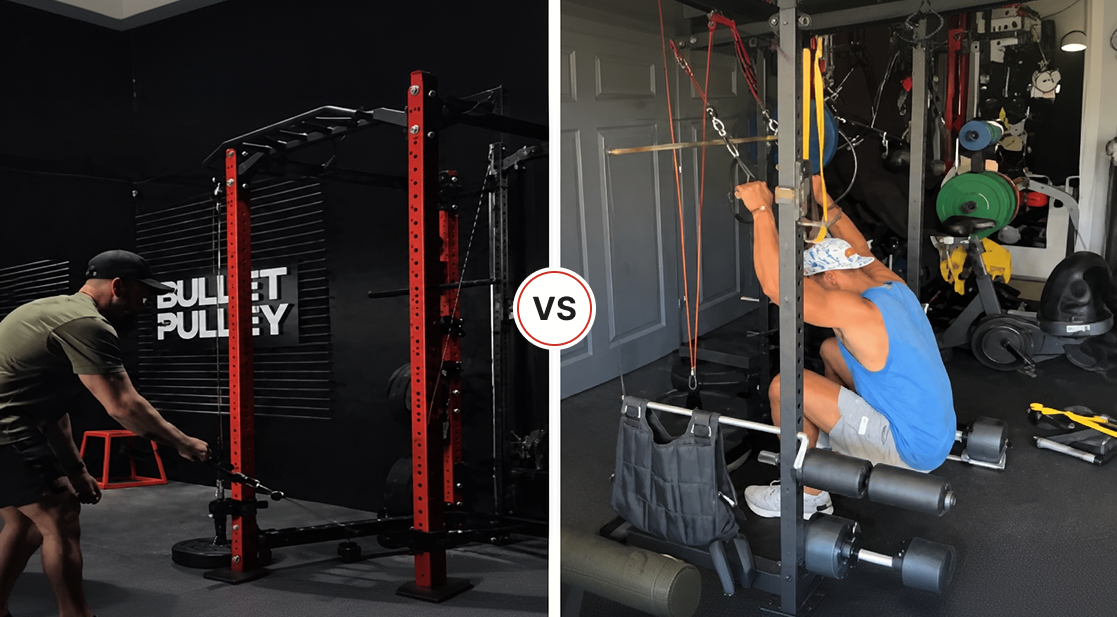
If you've ever planned a back workout at home, you've probably come across these two exercises: pull-ups and lat pulldowns.
They look similar. Both work your back, both involve pulling, and both can be part of a good training routine. But if you're setting up a home gym, you might wonder whether you need both or whether one is enough.
The answer becomes clearer when you look at how you actually use them.
Pull-Ups: Great When You Can Get the Reps In
There's something satisfying about getting through a set of pull-ups. You're lifting your own bodyweight, and as you get stronger, you can work toward more reps or eventually add weight.
But pull-ups aren't easy for everyone. If you're still working toward your first full rep, or you can only manage two or three, building a whole workout around them can be difficult.
You can use assistance to make the movement more manageable while you build strength. And if you're already comfortable doing pull-ups, they can remain a regular part of your back training.
The main thing to remember is that your bodyweight sets the starting challenge. You can change that with assistance or added weight, but it's not always easy to adjust the difficulty in small steps.
Lat Pulldowns: When You Want More Control
This is where lat pulldowns come in handy.
Instead of pulling your body toward a bar, you pull a bar or handle down toward your upper chest while staying in position. You can choose a weight that suits your current strength and adjust it as you progress.
That flexibility is useful when you're training at home. Maybe you're not quite ready for full pull-ups yet. Maybe you've already done your pull-ups and want to keep working your back without repeating the same challenge.
With a lat pulldown, you can focus on controlled reps without having to lift your entire bodyweight.
Set the pulley overhead, take a comfortable grip, and pull the attachment toward your upper chest. Let it return slowly rather than allowing the weight to pull your arms up. If you're leaning back or swinging to finish each rep, reduce the weight.
Simple, controlled reps will serve you better than chasing a number you can't manage properly.
So, What's the Difference When You're Training?
The biggest difference is how you handle the resistance.
With pull-ups, you're moving your bodyweight. Progress usually means completing more reps, improving your technique, using assistance, or eventually adding weight.
With lat pulldowns, you can change the load more directly. That makes it easier to start at a manageable level and increase the resistance gradually.
Both exercises train your lats and other upper-body pulling muscles, but getting stronger at one doesn't automatically mean you'll be equally strong at the other.
Comfort is worth considering, too. Pull-ups can be demanding on your grip and shoulders, especially if you're new to them. Lat pulldowns let you adjust the load and try different suitable attachments, although they still require good technique.
Neither exercise is automatically better for everyone. The right choice is the one you can perform comfortably and progress with over time.
Do You Need Both in Your Back Workout?
Not necessarily every time you train, but they can work well together.
If you're still building toward your first pull-up, start with lat pulldowns to train your back and practise assisted pull-ups separately.
If you can already do several pull-ups, you could begin your workout with them and follow up with lat pulldowns for additional back work. For example, try three sets of pull-ups followed by three sets of lat pulldowns for 10–12 reps, adjusting the volume to suit your training.
And if you prefer lat pulldowns, that's fine, too. You don't have to force yourself to do both exercises in every session to make progress.
The goal is to build a routine you can stick with, not to collect exercises for the sake of it.
Getting More Out of Your Garage Gym
One of the challenges of building a home gym is deciding which equipment is worth the space. A separate machine for every exercise isn't always practical, especially if your garage has to serve other purposes, too.
A cable setup gives you more options from the rack you already have. Bullet Pulley's 10-in-1 Kit includes a high-pulley configuration for lat pulldowns, provided your rack and setup are compatible.
That means you can add cable back training to your routine without necessarily dedicating floor space to a separate lat pulldown machine.
If you're looking to add more cable exercises to your home gym, take a look at the available kits and see what works with your setup.
Your Turn: Pull-Ups or Lat Pulldowns?
If you had to choose one for your next back workout, which would you pick?
Pull-ups are a challenge in moving your own bodyweight. Lat pulldowns give you more control over the resistance. Both can be useful, and what works best depends on your strength, goals, and setup.
Vote for your pick:
-
Pull-ups — I'd rather work on my bodyweight strength.
-
Lat pulldowns — I prefer being able to adjust the weight.
Cast your vote and see what other Bullet Pulley owners prefer.

Share:
Cable Pulley Back Workout for Women: Building Strength Without Bulk